 100% Local Team
 Est. 2005
 5.0
5.0 Construction
Construction Marketing and Web Design in Rhode Island
Websites, project photography, search and ads for Rhode Island contractors, engineers, site developers and infrastructure firms.
Construction work is won on relationships, on a number, and on who has done the job before. The website does not win it. The website is where you get checked. A developer with a shortlist opens three firms in three tabs and spends about a minute on each. A town engineer looks you up before your prequalification package moves to the next desk. A prime looking for a subcontractor on a job that breaks ground in the spring wants to see whether you have done that scope, at that size, for somebody like them. In every one of those moments your site is either doing its job quietly or taking you off the list, and nobody calls to tell you which one happened.
The gaps are almost always the same ones. A project list that stops a few years back, when the best work came after that. Photographs taken on a phone at the end of a punch walk, which make a finished job look like any other job. A services page that undersells half of what the firm self performs in the field. A careers section that is one line and an email address, in a market where every good estimator, project manager and foreman already has three places they could go. None of that shows up on a bid tab. All of it costs money, and it costs it quietly.
Black Door Creative has built websites and run marketing for Rhode Island companies since 2005, construction and engineering among them: civil and structural firms, site development contractors, telecom and utility infrastructure developers, commercial builders and specialty trades. Everything is done in house by our own team, working out of Cranston and Providence, so when a project wraps and you want it online before the next pursuit, you get a person on the phone instead of a support queue.
Since 2005
Services we offer for construction
Construction marketing in a small, crowded market
Rhode Island is small enough that the bid list rarely surprises anyone. The same firms walk the same sites, see each other at the same prebid meetings, and take turns being the low number. The people handing out work here, town engineers, facilities directors, school building committees, developers, property managers, have usually heard your name before they ever type it into Google. That changes what your website is for. Most of the searching done about a construction firm in this state is not discovery. It is verification. Somebody already has your name and is deciding how seriously to take you, and the thing they look at first is whatever you put online.
The work itself is shaped by things a national agency would never think to write about. Nearly every project passes through a local planning or zoning board, and every city and town runs its own with its own temperament and its own calendar. Coastal and flood review touches jobs that would be routine somewhere inland, and wetlands and stormwater questions land on the engineer long before they land on the builder. Public work brings its own paperwork, its own prevailing wage rules and its own schedule. A firm that is licensed and genuinely active across the line in Massachusetts and Connecticut is fishing in a far bigger pond than a firm that reads as strictly local, and the website is where that either comes across or quietly does not.
The firms that do well online here are not the ones with the most polished marketing language. They are the ones whose project pages show real scope instead of adjectives, whose site loads on a phone with one bar of signal in the middle of a site, and whose careers page reads like a firm that is growing. Everything below is aimed at those three things.
What we do
What construction companies buy from us
Each heading below is a service we run for construction in Rhode Island, and each one links to the full service page.

Web Design for Construction
For a construction or engineering firm the project portfolio is not a section of the website. It is the entire sales argument, and most sites bury it behind a slideshow. Construction web design starts from that fact. We build the portfolio the way a buyer actually reads one: filtered by sector, so a municipal client sees municipal work and a private developer sees private work, with each project carrying the scope, your role on it, what made it difficult and images big enough to be worth looking at. The person on the other end is trying to answer one question. Have you done this before, at this size, for someone like me. Everything on that page either answers it or gets in the way.
Underneath the portfolio sits the page nobody enjoys writing and every serious buyer reads. Call it qualifications or capabilities: licenses and registrations by state, professional certifications, the safety program, bonding and insurance, association memberships, small business or disadvantaged business status where you hold it, and an honest line between the disciplines you keep on staff and the ones you bring in. Written plainly and kept current, that page answers half of a request for qualifications before anyone opens the form. Left vague, it turns into a phone call, and the phone call is the one that does not come.
Two more things get designed in from the start, because in this industry they carry as much weight as the pursuit pages. The first is the careers section. Recruiting crews and project staff is worth as much as winning the work, sometimes more, and most construction websites treat hiring as a footnote with a mailto link. We build it as a real part of the site: what it is like to work there, what the benefits actually are, who the people are, and a form that lands in somebody's inbox the same day. The second is speed on a phone, because a lot of the people reading you are standing in a trailer or sitting in a truck with bad signal, and a site that crawls on a bad connection is a site they never actually saw. You can update the whole thing yourself, and you own it outright the day it launches.

SEO for Construction
Search around a construction firm splits into two completely different jobs. There are the people typing your company name, checking you out before a meeting, a bid opening or a board hearing, and there are the people typing what they need: a civil engineering firm for a subdivision, a site contractor for a commercial pad, a structural engineer for a retrofit, a company that can permit and build a tower site. You win the first group by controlling what comes back when someone looks you up. You win the second by having a real page for each thing you do, in each place you do it.
SEO for construction is mostly that second job, and it is unglamorous work. Separate pages for site development, utilities and underground, structural design, land surveying, permitting support, demolition, whatever your disciplines genuinely are, instead of one services page that lists them as bullets and ranks for none of them. Pages for the towns and the states you are licensed and working in, written with something real in them rather than the same paragraph with a place name swapped, because a page like that helps nobody and Google has been onto it for years. A Google Business Profile that is actually right, since even a firm with a yard and no walk in traffic gets found through the map results by municipal staff, property managers and other contractors. And all of it written in plain language, which is also what gets a firm quoted when somebody asks an AI assistant who handles this kind of work in Rhode Island, a growing share of how these searches start now.
Construction is a patient business and search rewards that temperament. An SEO campaign can take anywhere from 2 to 6 months to begin ranking, and we say so before you sign rather than after. We also ask for a 3 month minimum on monthly SEO, for the same reason: anything shorter is a test nobody can read. The upside is that bid cycles here are long enough to match. A developer who finds you in March may be selecting in the fall, so the work you start now is aimed at next year's pipeline rather than next week's, and that is exactly the horizon most construction firms already think on.

Google Ads for Construction
Paid search is not the right tool for every construction firm, and we would rather say so up front than take the budget. If your work comes off public bid lists and repeat primes, Google Ads is unlikely to change your year. If you have a division that sells to private clients directly, a specialty trade people search for by name, a service arm that handles emergency or on call work, a residential or light commercial side, or a hiring problem you need solved before a project starts, paid search can start producing inside the first week.
The failure mode in this industry is expensive and extremely common. Construction keywords attract everybody. Homeowners looking for a handyman click on ads meant for developers. Students researching papers click. Out of state firms fishing for subcontractor work click. So do the vendors who want to sell you estimating software. We build campaigns with the negative keywords, match types and geography tight enough that you are paying for the inquiries you actually want, write the ads, build the page each one lands on, and track which keyword produced the call or the form. On a business where a single project can carry a season, knowing what a real inquiry costs matters far more than what a click costs.
Recruiting is the use we get asked about least and recommend most. When you need field staff or a project engineer before a job starts, a tight campaign aimed at the trades you are short on, pointed at a careers page that has actually been written, moves faster than a sign on the fence and reaches people who are working rather than looking. It is the same machinery as lead generation, turned around to face the other side of the business. We also throttle it. Ads go up when the pipeline needs filling and come down when the schedule is full, which is a conversation we would rather have every quarter than never.

Digital Marketing for Construction
Most construction firms come to us for a website and stay for the monthly work, because the thing that kills a construction website is almost never the design. It is neglect. The project list ages out. The team page still lists people who left. The last news post announces a groundbreaking for a building that has been open and occupied for years. Digital marketing is the arrangement where that stops being somebody's Friday afternoon problem: one team on the search, the ads, the content and the reputation, one plan, and one report a month written in plain English instead of a dashboard nobody opens.
For a construction or engineering firm the recurring work has a particular shape. New projects written up and posted as they finish, using the images that came out of the shoot rather than whatever was on a phone. Certifications, awards, new hires and promotions put somewhere they can be found, because in this industry those are the proof points that travel. Reviews asked for and answered, since a firm with almost no reviews sitting next to a competitor with a page of them loses a comparison it never knew was happening. A LinkedIn presence kept alive, because that is where the architects, developers and municipal staff who hire firms like yours actually spend their working day. And the site itself maintained, so the qualifications page does not quietly go stale the month your registration renews.
The other piece is the list you already have and almost certainly do not use. Past clients, developers, primes, architects, engineers, the people who have worked with you and would again if you crossed their mind at the right moment. An occasional, short note with a finished project in it is the cheapest marketing in this business, and it is the only audience you are not renting from somebody. All of it runs through one point of contact, so nobody at your firm is forwarding the same job photos to three vendors who have never spoken to each other.

Photography and Video for Construction
A finished project is the best sales material your firm will ever produce, and for most firms it exists as a folder of phone pictures taken by a superintendent on the last day, half of them into the sun. Those are documentation and they are fine for what they are. They are not what should be carrying your portfolio, your qualifications package, your proposal cover or the ad you are about to run.
Photo and video for construction means shooting the work at the level it was built. Finished projects at the hour the light actually works on that elevation. Drone footage for the jobs that only make sense from above, which in site development, utility and infrastructure work is nearly all of them, and which is the single thing that makes a civil or site package look like a firm operating at scale. Progress coverage on the projects worth documenting from clearing through closeout, so you end up with a sequence rather than an after shot. Crews and equipment working, because that is the imagery that recruits and it is the imagery almost nobody has. Real portraits of the people a client will deal with, so the team page stops looking like a placeholder.
We shoot around your schedule and your site rules, which is not a small thing. Active sites have access requirements, safety orientations and a window of about an hour when the light and the work line up, and a photographer who has never been on one burns all three. What you get back is a library rather than a handful of frames, and it feeds everything downstream: the project pages, the proposals, the ads, the hiring posts, the trade publication that calls about the job. Firms that have never had a proper shoot are usually surprised how much of the gap between them and the firm they keep losing to was photography.

Branding and Logo Design for Construction
A construction mark has a harder job than a mark in almost any other industry. It has to survive being cut in vinyl on a truck door, printed on a job sign that sits in weather for a year, embroidered on a jacket, stamped on a drawing set, screened onto a hard hat, reversed out white on a dark proposal cover, and shrunk to a circle beside your name in a search result. Plenty of the marks we are asked to redraw were designed on a screen by somebody who never watched one get installed on a gate.
Logo design and branding in this industry usually arrives with a reason attached. A firm that added a discipline and outgrew a name describing only the old one. A second generation taking over and wanting the mark to look current without discarding a name every town clerk in the state already recognizes. A merger that left two identities running side by side on two sets of trucks. A firm that moved from residential into commercial and still looks like the smaller version of itself. We keep what is genuinely worth keeping and fix what has gone soft, because in a market this small the recognition you already have is an asset, not an obstacle.
What you get is the whole kit rather than a file. The mark and its variations, type, color, the versions that hold up in one color and reversed, truck and equipment graphics, site signage, hard hat and apparel treatments, proposal and drawing set templates, business cards, and the profile image that shows up in the map results and beside your reviews. A brand that stops at the website is half a brand in an industry where most people see you first on the side of a truck in traffic.
5.0 Reviews from our clients
Verbatim from our Google Business Profile. Names are real and you can look every one of them up.
SOS Plumbing & Heating has been working with Rob at Black Door Creative for almost a year, and the experience has been excellent. They've handled everything from our marketing and website to improving our day-to-day customer flow. It's been a huge benefit having someone local and genuinely accessible, especially after dealing with larger companies where communication gets dragged out and nothing seems to move forward.
Rob and his team at Black Door Creative really knocked it out of the park for my company!!! We are now on solid footing with SEO, development and Google Ads and we cannot thank you enough!
We had the pleasure of working with Black Door Creative to build a new website. We couldn't be more pleased with the results. From start to finish, their team excelled in communication.
We couldn't be happier with the amazing job Black Door Creative did with creating our new website. Rob was responsive and always updated our website whenever we needed it.
Rob and Thalia at Black Door Creative surpassed every expectation we had when we set out to rebuild our website and digital presence. Their communication, marketing insight, design skills, and affordability are second to none.
I was looking to hire a designer to help redesign a website for my landscaping & construction company. After much research I found Rob and he wasted no time in setting up a consultation with me. His attention to detail and knowledge was what made me comfortable moving forward. I cannot say more about his customer service and patience.
Recent work
Construction work you can look at
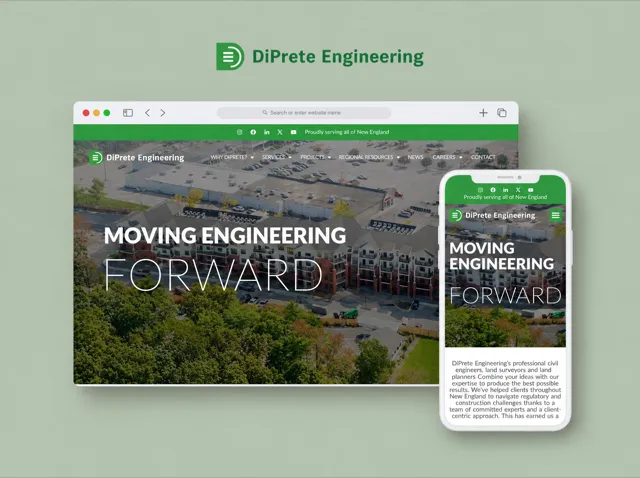
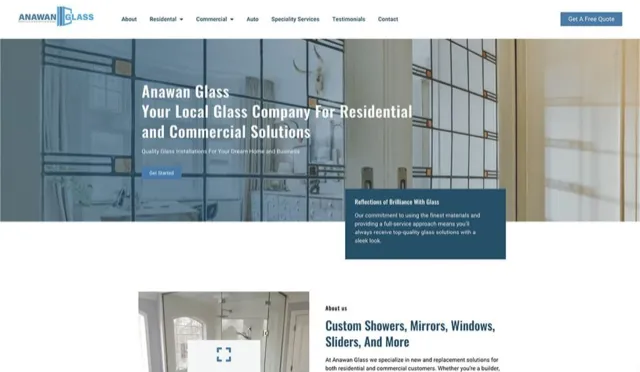
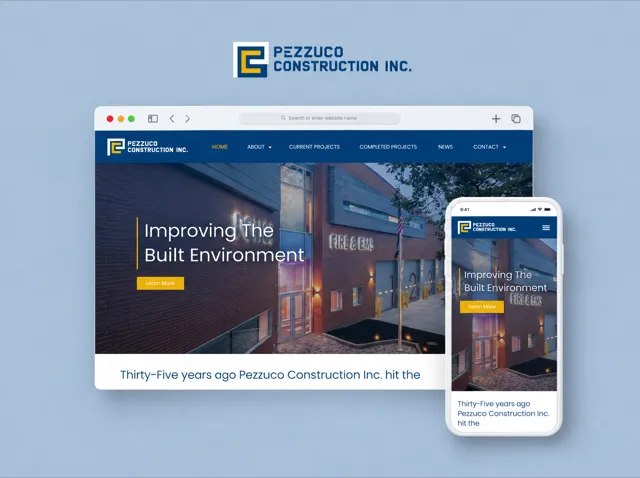
Real clients, named, with what we actually did for each. See every construction project in the portfolio.
FAQ
Construction marketing questions
Don't see yours? Ask on the contact page or call (401) 339-4155.
It depends on the size of the project portfolio, how many disciplines and markets need their own pages, whether there is a careers system behind the hiring section, and whether we are shooting the projects too. Our web design page carries the starting point in writing, and we quote the rest before any work begins. You will never see an invoice for something you did not approve, which is a standard we suspect you already hold your own subcontractors to.
Yes, and that is the order we prefer. A portfolio designed around real photography of your work is a different object from the same portfolio built around whatever images survived. We schedule the shoots early, work around site access and safety requirements, and if the best recent job is already finished and occupied we shoot it as a finished building, which for most construction and engineering work is exactly how a client wants to see it anyway.
Less than it is worth to a firm selling privately, and more than nothing. Public work still gets verified: committee members, town staff and competitors all look you up, and what they find is a ranking problem as much as a content problem. Beyond that, a good position in search brings in the private side of the business, the subcontractors who want to get on your list, and a steady trickle of job applicants. We will tell you honestly if ads or content would do more for you than rankings.
It is one of the two things a construction website does best, alongside getting you through a vetting. Most firms lose applicants at the careers page, which is usually a job title and an email address. A real section, with what the work is, what the benefits are, who the crew is, and a form that lands in the right inbox, changes how many people finish the application. Add project and crew photography and a modest recruiting campaign and you are competing for people properly instead of hoping.
Whichever you prefer. We build the portfolio so your marketing coordinator or office manager can add a project in a few minutes without calling us, and plenty of firms run it that way. If nobody there has the time, and in construction that is the usual answer, new project write ups are part of the monthly digital marketing plan and we chase you for the photos.
Why us
Why Rhode Island construction firms hire a local agency
We are in Rhode Island, we have been here since 2005, and that is more than 20 years of watching how work gets awarded in this state. It matters more than it sounds. An agency somewhere else does not know that the buyer might be a town staff small enough to fit around one table, that a review board hearing can decide a schedule, or that the firm you are bidding against has an office ten minutes from yours and has known the same people for as long as you have. We write and build for that reality rather than a generic national one.
It also means you get a person. When a project finishes, when a certification renews, when a qualifications page needs a line changed before a submission goes out Friday, you call somebody who knows your firm rather than opening a ticket and waiting. Everything here is done in house by our own team, the photography and the code both, and we have launched over 500 websites since 2005, so very little about a build surprises us anymore.
Every construction and engineering project we have shipped is in the portfolio, named, so you can inspect the work instead of taking our word for it. Call (401) 339-4155 or start a project and tell us what your current site is costing you.
Where to next
What construction usually need first
Marketing help for your construction business
Tell us what is not working. Twenty minutes, no pitch deck, and you will leave the call knowing what we would do and what it costs.
Start a project → (401) 339-4155
Not ready for a quote? Get a free site review instead.